What is Agentic AI
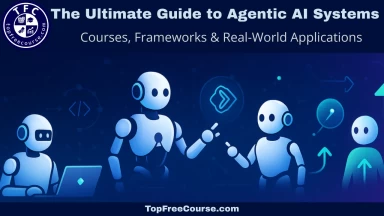
Agentic AI is a popular topic; it is a more advanced artificial intelligence system designed to act autonomously. This means Agentic AI can make autonomous decisions, perform acts, and even learn to achieve specific goals with minimal human interaction. Just like virtual assistants, these AI systems can go beyond planning, reasoning, adapting, and even interact dynamically without requiring consistent direction.
In the past decade, the way humans intercommunicate with AI has taken a striking leap forward with generative AI (gen AI) and agentic AI. Imagine AI agents that can plan your next vacation and make all your travel arrangements, humanoids that act as virtual Caretakers for elderly people, or AI-powered supply-chain specialists robots that can manage inventories in real-time demand. These are just the opportunities opened up by the upcoming phase of agentic AI.
How Does Agentic AI Work?
Agentic AI is designed to function like an autonomous AI agent, powered by advanced technologies including large language models (LLMs), Generative AI, Machine learning (ML), natural language processing (NLP), and Traditional programming. This combination ensures that agents follow specific rules and constraints, providing structure and reliability. These agents can detect and respond to changes in their environment, make decisions, and take purposeful actions to achieve specific goals over time without requiring constant human supervision.
Agent Architecture in AI
Agentic Architecture in AI refers to the overall workflow structure and design of a system that enables AI to behave autonomously within an agentic AI system, as well as how it perceives the environment, makes decisions, and takes actions to achieve its goals.
Here, we will explain the different types of AI agent architecture.
Reactive ArchitecturesThis module responds immediately to changes in the environment, it has no memory or internal state, and is used in early robotics.
Deliberative Architectures
This memory module enables the agent to Plan actions by learning from prior experiences.
Hybrid Architectures
This module is the advanced version of the combined reactive and deliberative layers. It is capable of Fast response and long-term planning.
BDI Architecture
DBI refers to Belief–Desire–Intention, a model that incorporates human-like reasoning, Including Beliefs, Desires, and Intentions, and is widely used in multi-agent systems and simulations.
Agentic LLM Architectures
This modern system is built around large language models like GPT. It is capable of incorporating planning, tool use, memory, and reflection.
Agentic AI Frameworks
The Agentic AI frameworks are software toolkits or libraries that help developers build, deploy, and manage AI agent systems. These systems have embedded capabilities to achieve specific goals, including:
• Recognize changes in its operational context.
- Initiate or respond to task directives.
• Plan actions or steps to achieve those goals.
- Use tools, APIs, or software autonomously.
• Monitor and adjust its behavior based on feedback or new information.
Let's dive into the currently popular agentic AI frameworks
LangChain A modular framework designed to build applications powered by large language models (LLMs). It focuses on simplicity and providing tools for memory management and integration with vector databases. More
CrewAI CrewAI is an orchestration framework designed to develop multi-agent collaborative AI systems where agents play specific roles. (e.g., writer, editor, planner).
Auto-GPT Auto-GPT is an Autonomous GPT-based agent system that loops over tasks until the goal is reached. It uses GPT (Generative Pre-trained Transformer) to create, prioritize, and complete tasks iteratively.
Microsoft Semantic Kernel (SK) Open-source SDK (Software Development Kit) for building intelligent agent-based applications, using LLMs and conventional programming for integrating with existing systems.
Microsoft AutoGenOne of the most powerful and flexible open-source frameworks for building multi-agent AI applications to perform complex tasks, with a focus on code generation, reasoning, and orchestration.
RasaThe most popular Open-source framework for conversational AI to build chatbots and voice assistants, with robust support for natural language understanding (NLU) and dialogue management.
OpenAgentsAn open-source platform designed by OpenAI to build, host, and manage specialized AI agents. It supports agents that handle data analysis, automate web browsing, and integrate with plugins to boost efficiency
The right agentic framework aligns with your goals and can help build specialized AI agents that automate workflows to achieve specific tasks.
Difference Between Agentic AI and Generative AI
Agentic AI and Generative AI both represent artificial intelligence, but work on different fundamentals. Let's see the key differences between them:
• Agentic AI achieves goals through autonomous actions, while Generative AI creates content like text, images, code, etc.
• Agentic AI Plans, makes decisions, and takes multi-step actions while Generative AI responds to prompts with generated output.
• Agentic AI is capable of performing complex, multi-step tasks, such as booking a trip or coding an app, while Generative AI focuses on Single-turn tasks, including writing and image creation.
• AutoGPT, OpenAgents, and Microsoft AutoGen are the best examples of agentic AI, while ChatGPT, DALL·E, and Midjourney are examples of generative AI.
• Agentic AI can set, pursue, and adjust goals dynamically, while Generative AI doesn’t decide goals – waits for instructions
Agentic AI and Generative AI both have different functionalities, different autonomy, task scope, and different use cases. Learn More.
Agentic AI Examples and Use Cases
Just imagine an AI agent that doesn’t rely on manual step-by-step commands — it takes action. That’s the power of agentic AI, a game-changing approach driving innovation across industries. As of 2025, agentic AI systems are actively powering large-scale operations in various sectors. From cybersecurity to supply chain management, Customer Services to Finance, and Healthcare to drug discovery, agentic AI can help businesses automate complex, multistep tasks in real-time.
Let's dive into the practical applications of agentic AI in various fields. Through real-world examples, we’ll reveal its automation strengths, giving you insights into how it can elevate your organization’s performance.
Customer Services
• AI agents can answer FAQs and handle routine customer inquiries.
• Processing returns or order updates.
• Deal with challenging tasks and provide support to human agents.
• Deliver round-the-clock personalized assistance.
Healthcare
• Agentic AI can assist doctors with diagnosis and analyze patient data. (lab results, imaging, EHRs)
• Recommend personalized treatment plans and patient care management.
• AI agents can provide 24/7 support to patients, offering guidance on their conditions.
• Conversational AI agents provide emotional support for mental health.
• Agentic AI remarkably accelerates drug discovery by analyzing large amounts of data.
Supply Chain and Logistics
• Agentic AI accelerates operational efficiency.
• Optimizing delivery routes based on real-time traffic and weather conditions.
• Manage inventory and monitor the supply chain based on real-time demand.
Cybersecurity
• AI agents actively monitor digital environments.
• Uncover threats and system vulnerabilities by monitoring network behavior
• Automatically block or insulate threats before they cause damage.
• Uses machine learning to improve over time.
Finance
• Manages routine tasks, including submitting expenses and conducting compliance reviews.
• Analyze market trends and provide customized financial advice.
• Gives personalized investment advice based on their profiles.
Other Use Cases of Agentic AI
• Workflow Automation in various sectors, including HR, IT, Marketing, and many more.
• Agentic AI in Manufacturing: Manage production, monitor machinery health, and predict maintenance.
• In scientific Discovery, autonomously suggests, plans, and executes chemical experiments to discover new
compounds.
• Agentic AI in Autonomous Vehicles processes sensor and navigation data in real time, making quick driving
decisions to improve safety.
• Educational agents deliver 1:1 customized lesson plans based on student learning style and pace.
Agentic AI Career Opportunities & Jobs
AI Agent Developer
To become an AI agent developer, you need to learn Python, LLM APIs, reinforcement learning, and frameworks like AutoGen, LangGraph, and Semantic Kernel. They are responsible for designing, developing, and training
autonomous AI agents that can plan, act, and learn from environments.
Multi-Agent System Engineer
As a multi-agent system engineer, you need to become a master in skills including distributed systems, communication protocols, orchestration tools, and agent planning models. They build systems where multiple AI agents collaborate to achieve complex goals.
Prompt Engineer (Agent-Oriented)
Agent-oriented prompt engineers design structured prompts and task flows for agents to reason, reflect, and act
effectively. They are experts in NLP, task design, prompt chaining, and few-shot learning techniques.
AI Product Manager – Agentic Systems
To become an AI product manager, you need to learn Product strategy, user experience, AI model integration, and team collaboration. They are Responsible for formulating the objectives and guiding the rollout of agent-based
applications and platforms.
Autonomous Process Designer
Skills needed to become an autonomous process designer are Business analysis, workflow design, and
understanding of automation tools like Zapier, Make, LangChain, etc. They are responsible for
Mapping real-world business or user processes into AI-driven agentic workflows.
Ethics & Governance Specialist – Agentic AI
They are experts in AI policy, safety frameworks, auditing, and legal compliance, and are responsible for ensuring AI
Agents behave safely, responsibly, and within legal/ethical boundaries.
Explore Remote Job Opportunities and Resources from worldwide at TopFreeCourse.com
Best Free Agentic AI Course and Learning Resources
• Introduction to Agentic AI
Conclusion
Agentic AI, the next big thing in AI, is no longer a concept of the future; it's becoming essential in today’s fast-paced
world. These advanced AI systems are transforming the way we live and unlocking new levels of efficiency,
autonomy, and innovation across every sector. AI agents perceive environments, set goals, make decisions, and take action independently, without waiting for step-by-step instructions. Beyond that, it's capable of coordinating with
multiple AI agents, replicating human teamwork to solve problems, delegating tasks, and adapting in real time.
In 2025, mastering the tools, frameworks, and techniques behind agentic AI for free with TopFreeCourse.com and
stepping into the next frontier of innovation. Whether you're a developer, entrepreneur, or business leader,
understanding how agentic AI works puts you at a strategic advantage, enabling you to design smarter systems, drive efficiency, and lead in a world that increasingly depends on autonomous intelligence. Join TopFreeCourse.com and
start learning for Free now!